


Complete Beginners’ Guide to Foam Adhesives
15.09.2026
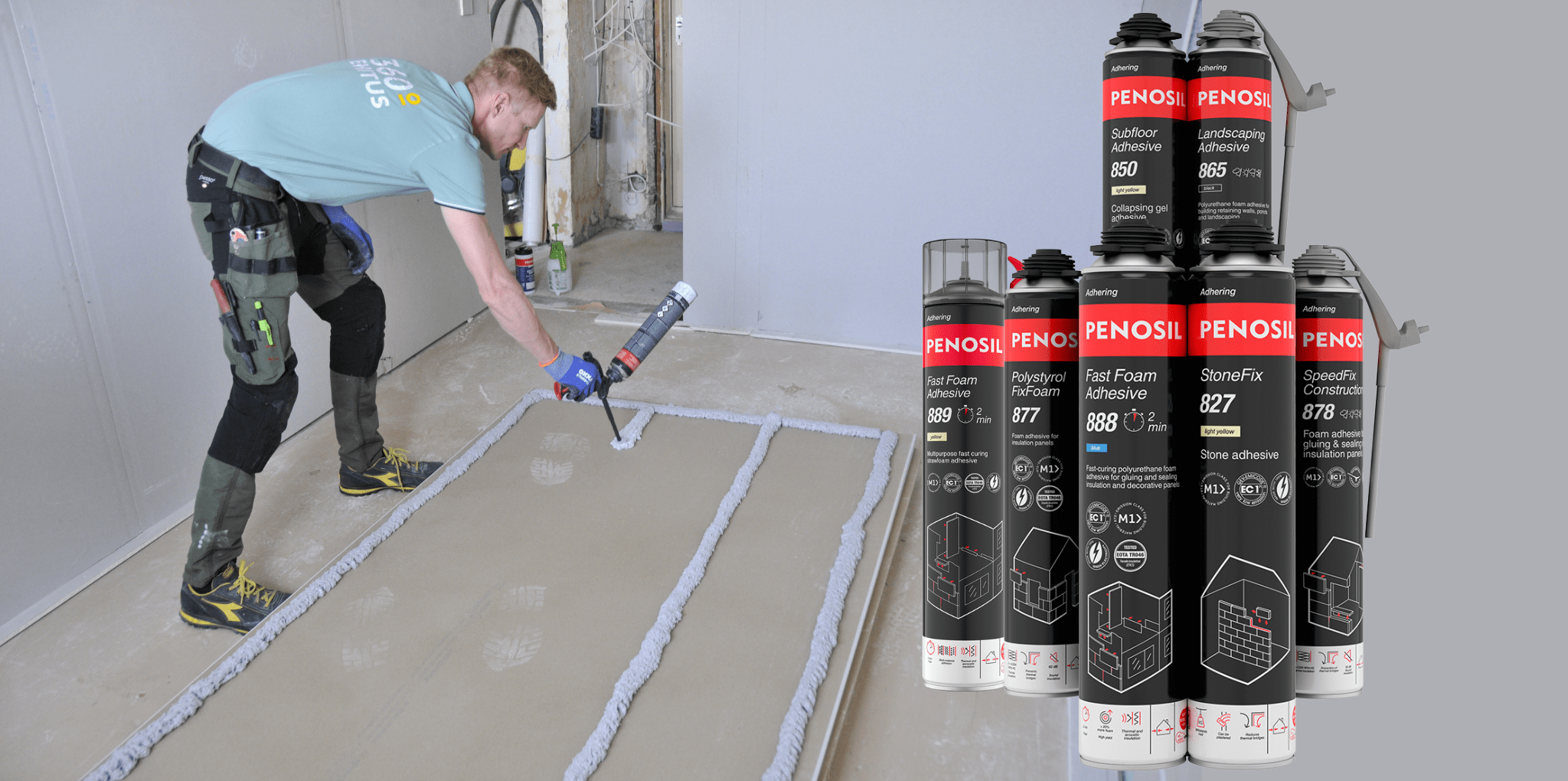
Foam adhesives are one-component polyurethane adhesives that come in pressurised cans. Applied using a foam gun or straw applicator, they expand slightly after application and cure through reaction with moisture in the air, forming a strong and long-lasting bond. In terms of performance, foam adhesives share many characteristics with standard PU foams, including excellent thermal and sound insulation.
How Do Foam Adhesives Differ From Traditional Construction Foams?
The key differences are the foam adhesive’s higher froth density and lower post-expansion. The higher froth density during application guarantees a strong and even bond between glued surfaces, while the controlled post-expansion allows materials such as insulation boards to be fixed securely without the risk of warping.
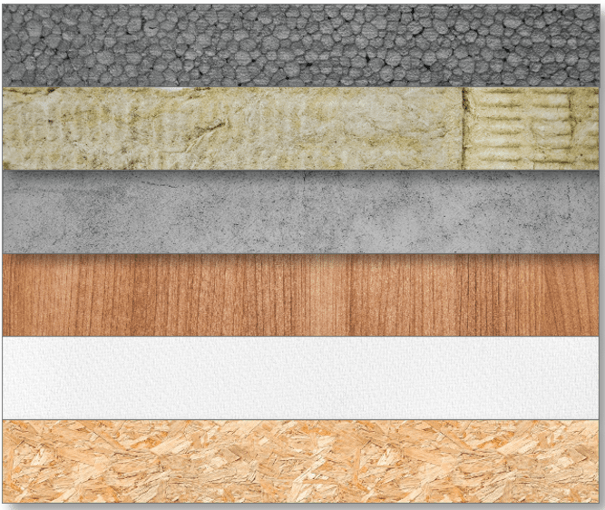
With an average bonding strength of 0.12 MPa, Penosil foam adhesives have strong adhesion to most common building materials such as:
- Insulation boards
- Hard wool
- Concrete
- Wood
- Plasterboard
- Construction panels
- Bricks
- Blocks, etc.
In addition, all Penosil foam adhesives are tested and certified by independent third parties. They meet strict emission standards, including EC1+ and M1, and, depending on the product, also comply with EOTA or ASTM certification requirements.

As a result, foam adhesives have become a practical and cost-effective alternative to traditional bonding methods such as mortar, screws and cartridge-based adhesives. Their fast application, strong adhesion and excellent insulating properties make them a versatile solution for a wide range of construction tasks.
Advantages Over Traditional Mortar
Foam adhesives offer several advantages over traditional bonding methods such as mortar. They are much faster to use, create no mess during application, and require significantly less product.
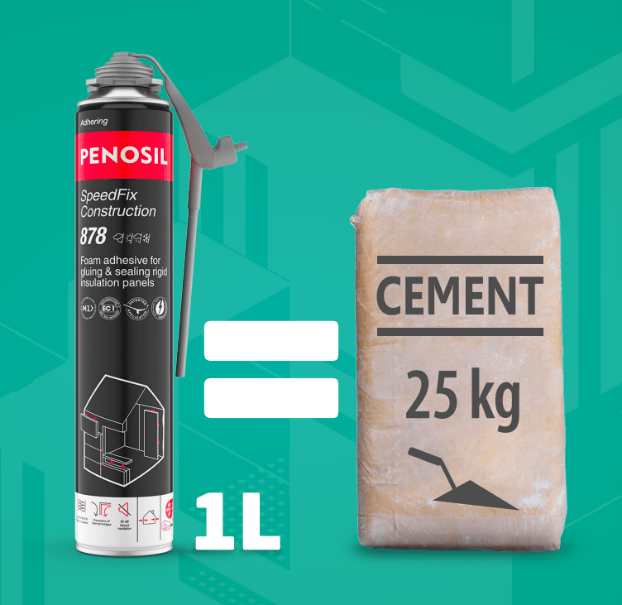
1. Material Savings
A 1 L can of foam adhesive equals 25 kg of cement. Foam adhesives are lighter, much easier to handle and have a much lower transportation carbon footprint.
2. Speed
Compared to traditional mortar, foam adhesives significantly reduce installation time. The foam adhesives are ready-to-use; simply shake the can and apply. Tack-free time is around 7 minutes, load time is around 2 hours, and curing is significantly faster than for mortar-based solutions.
3. Excellent Insulation Properties
Using foam adhesives is an effective way to reduce thermal bridges in buildings. With thermal conductivity as low as 0.033 W/(m·K) and sound insulation value as high as 62 dB, foam adhesives are one of the insulation materials with the lowest thermal conductivity available.
4. Versatility
Foam adhesives can fill gaps and accommodate structural movement. Unlike mortar, which typically requires installation temperatures above +5°C, many foam adhesives can be applied below 0°C.
Choosing the Right Foam Adhesive
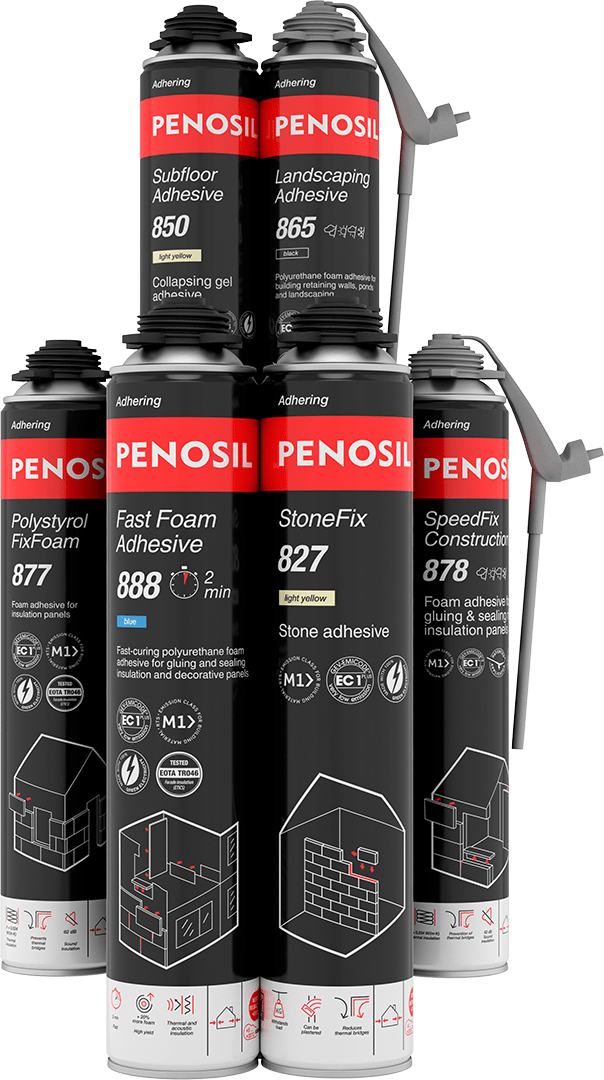
When choosing a foam adhesive, the most important factors to consider are material compatibility, application type and working temperature. For instance, some foam adhesives are specially developed for bonding insulation boards (Penosil Polystyrol FixFoam 877), while others are designed for building non-load-bearing walls (Penosil StoneFix 827).
When choosing a foam adhesive, it is also important to consider the product’s temperature sensitivity. When carrying out work in late autumn and winter, an all-season foam adhesive should be used. For example, Penosil SpeedFix Construction 878 can be used even with outside temperatures as low as -5°C.
| Typical applications: | 878 | 877 | 827 | 888 | 889 | 865 | 850 |
|---|---|---|---|---|---|---|---|
| Fixing insulation boards on facade and foundation | ✅ | ✅ | ✅ | ✅ | |||
| Fixing interior wall boards | ✅ | ✅ | ✅ | ✅ | |||
| Fixing windowsills | ✅ | ✅ | ✅ | ✅ | |||
| Fixing blocks and bricks to build non-load-bearing interior walls | ✅ | ✅ | |||||
| Installing plinths, profiles, decorative and insulation boards | ✅ | ✅ | ✅ | ||||
| Installing carpentry, wooden and plaster decorative elements | ✅ | ✅ | ✅ | ||||
| Filling cavities in foundations, crawlspaces, trees, etc | ✅ | ||||||
| Crafting landscapes and directing water flow in ponds | ✅ | ||||||
| Filling plant pots to secure artificial plants | ✅ | ||||||
| Installing wooden subfloors and decking | ✅ | ||||||
| Wood-to-wood horizontal assemblies | ✅ |
By considering these main factors, you can choose a foam adhesive that will provide a strong, durable bond for your specific construction task.
Foam Adhesive Application Techniques
Preparation
- Always wear protective gloves, safety glasses and clothes with long sleeves when working with foam adhesives. Avoid skin contact. If you do get wet foam adhesive on your skin, remove it immediately either with Penosil Cleaning Wipes 941 or solvent.
- To ensure maximum adhesion, clean the surfaces thoroughly before application.
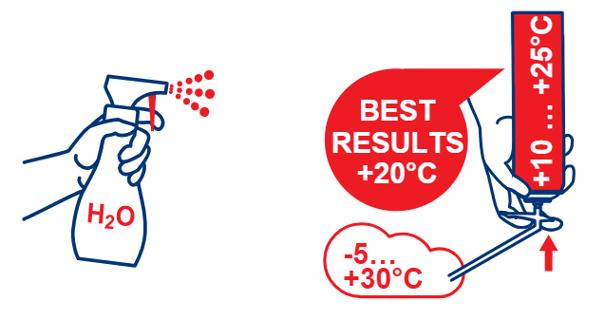
- For the best adhesive properties and maximum yield, your foam adhesive canister should be at room temperature (around +20°C) during application. If the can is cold, warm it gradually by leaving it in a warm room for a few hours or placing it upright in lukewarm (not hot) water. Never expose it to open flames or high heat, as the pressurised canister may explode.
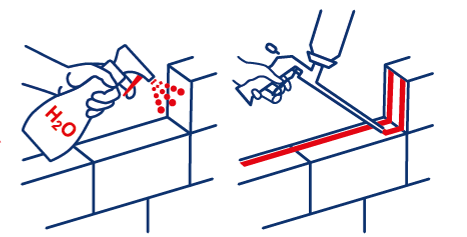
- Foam adhesive needs moisture to expand and cure properly. Lightly mist (it should be damp, not wet) the surfaces with water before application.
Application
- Before attaching the can to the gun, shake it vigorously at least 20 times to thoroughly mix the components.
- FOAM GUN: Hold the foam can upright and screw it onto the gun’s adapter. You can adjust the foam adhesive extrusion speed and volume with the gun trigger and adjustment screw.
- Do not screw the can onto the gun with the valve upside down or bend the can during screwing. Do not aim the gun at people and never smoke during application.
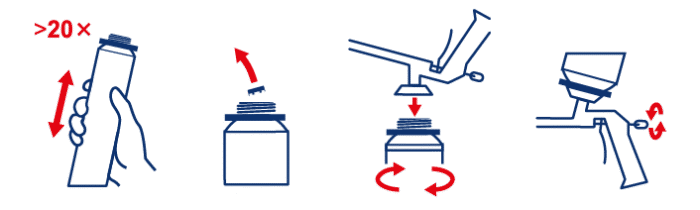
- STRAW APPLICATOR: Attach the applicator tightly onto the can valve.
- Always hold the can upside down during application.
- Before starting to work, extrude a small amount of foam (1–2 sec) into a waste bin to clear any air bubbles or residue from the gun.

Application Patterns
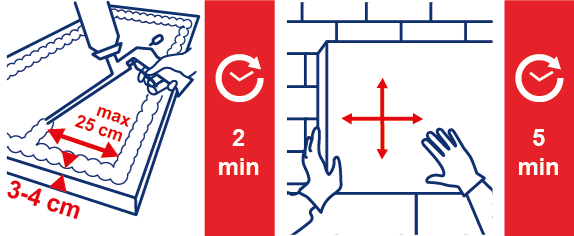
- INSTALLING PANELS AND BOARDS: Place the element to be installed flat on the floor with the bonded side up. Apply the foam adhesive in continuous lines along the element perimeter, about 3 to 4 cm from the edge. Depending on the element size, add one or more adhesive foam strips in the middle (max. 25 cm between adhesive strips), applied parallel to the longest side.
- Ensure that the total bond area after joining the surfaces together is at least 40% of the elements surface.
- Depending on the product, wait for a few minutes and then press the element onto the wall or other surface and adjust within the working time indicated on the product label.
- When applying foam adhesive on vertical surfaces, always work from bottom to top.
- BUILDING NON-LOAD-BEARING INTERIOR WALLS: The first row of blocks must be well leveled using mortar.
- Foam adhesive should be applied to both vertical and horizontal surfaces. Wait for a few minutes after applying the foam adhesive and then press the stone surfaces together.
- Foam adhesive can only be used in case even distribution of loads from block to block is ensured.
Storage
- Always store and transport foam adhesive cans in an upright position. Keep them in a cool, dry place (between +5°C and +30°C).
- As the foam cans are pressurised, never store them near heat sources, in direct sunlight, or at temperatures above 50°C.
- Typically, the foam adhesive shelf life is 12 months; always check the expiry date before use.

Frequently asked questions
Foam adhesives are one-component polyurethane adhesives in aerosol cans. They are very similar to regular construction or PU foams. The main difference is that the foam adhesives have higher froth density and lower post-expansion, meaning that they will have a stronger and more even bond between glued surfaces than a regular construction foam would have.
Generally, PU foams and foam adhesives are not waterproof and should not be used in applications where they are exposed to continuous contact with water.
An exception in the Penosil portfolio is Penosil Landscaping Adhesive 865, which is suitable for applications such as directing water flow in ponds and waterfalls.
There is no single foam adhesive that is suitable for every application. Products designed to do everything rarely deliver the best performance in every task, so the right choice depends on the materials and type of work.
For installing insulation boards in ETICS facade systems, fixing construction boards and elements, or bonding windowsills, choose Penosil SpeedFix Construction 878 (for use with a foam gun or the included EasyGun applicator), Polystyrol FixFoam 877 (gun foam), Fast Foam Adhesive 888 (gun foam), or Fast Foam Adhesive 889 (straw foam).
For more specific applications, use a product designed for the task. Penosil StoneFix 827 (gun foam) is intended for building non-load-bearing interior walls, Subfloor Adhesive 850 (gun foam) for installing wooden decking and subfloors, and Landscaping Adhesive 865 (can be used with foam gun or EasyGun applicator) for bonding elements in landscaping and garden construction.
No. Like construction foams, foam adhesives are not UV-resistant. If cured foam adhesive remains exposed to sunlight, it will degrade over time.
To protect it from UV exposure, cover any visible cured foam adhesive with paint, sealant, filler or another opaque material as soon as possible after curing.
Penosil foam adhesives have guaranteed shelf life between 12 to 18 months from production date. You can check the best before date under the can. Do not use expired products, as their structure and performance may deteriorate and reliable adhesion can no longer be guaranteed.
Foam adhesive must be stored in a cool and dry place between +5°C and +30°C. As the adhesive canister has gas inside it, do not keep it near heat sources or in direct sunlight, the can might explode when overheated.
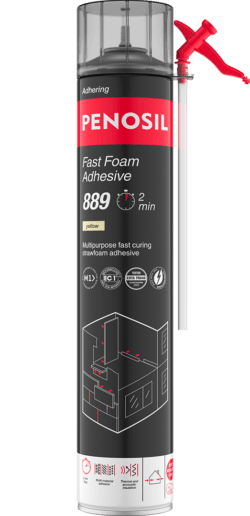
As the name suggests, the fastest-curing foam adhesives in the Penosil range are Fast Foam Adhesive 888 and Fast Foam Adhesive 889. Both of these products are designed for fast installation work, with an adjustment time of approximately 1–2 minutes, a tack-free time of 2–3 minutes, a cutting time of 20 minutes, and a load-bearing time of approximately 1 hour.
The main difference lies is their application method: Fast Foam Adhesive 888 is applied with a foam gun, while Fast Foam Adhesive 889 is applied with a straw applicator.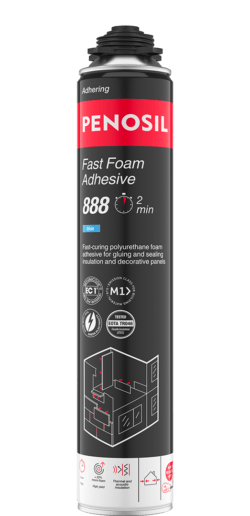
Cured or hardened foam adhesive can be softened with Penosil Foam Remover 995 and then removed mechanically.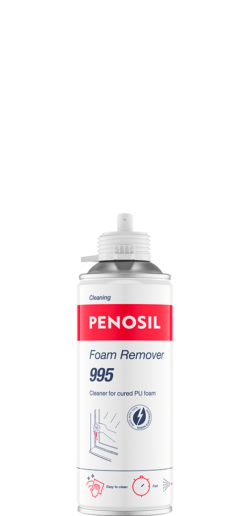
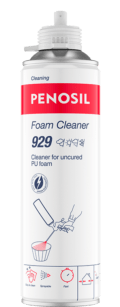

Fresh or uncured polyurethane foam adhesive is much easier to remove than cured material. Use a suitable solvent-based cleaner, such as Penosil Foam Cleaner 929 or Cleaning Wipes 941, to remove fresh foam adhesive residue from surfaces, clothing and tools.
Do not forget to clean the foam gun inside and outside with Penosil Foam Cleaner 929 once you have finished working.
Yes, you can build non-load-bearing interior walls using Penosil StoneFix 827. Bear in mind that the first row of blocks must be well leveled using mortar. Foam adhesive can only be used in case even distribution of loads from block to block is ensured. This is much faster application method than with mortar.
Conclusion
Foam adhesives are a versatile and effective solution for bonding a wide range of materials. Their strong bonding capabilities, flexibility, and durability make them an ideal choice for many applications. In addition to creating a durable bond, foam adhesives also provide good thermal and sound insulation and help to reduce the effect of thermal bridges in buildings.
Whether you need a strong, permanent bond for gluing construction blocks or a durable, flexible bond for fixing insulation boards, in the Penosil range, there is a foam adhesive that can meet your needs.
Learn more about adhesives from our other articles:
Extra-fast and strong bond with Penosil’s new Fast Foam Adhesive 888
Ultimate guide to plasterboard installation with Penosil
How to mount insulation boards with foam adhesive?
Why to Use Foam Adhesive for Facade Insulation Works